Learning Outcomes for this Module
- LO2: Critically assess information sources in pursuit of various purposes.
- LO3: Ask thoughtful questions.
- LO5: Annotate and cite information sources accurately and ethically.
- LO6: Reflect upon your own research process.
Tools
| What You’ll Need | What We Used |
|---|---|
| Forum for student posts (2) | Padlet |
Note to instructors
We update the linked articles in Part 4 to keep current with the news cycle. The articles linked here are from the Spring 2025 semester.
Additionally, for Part 4 we ask student to use skills from the Understanding URLs module.
How to Credit Us
Except where otherwise noted, the lesson plans on this site are licensed under a Creative Commons Attribution-NonCommercial-ShareAlike 4.0 International license.
To credit us for this module/lesson plan, cite the following:
Newman, J., Ward, S.K.L. (2025, July 14). Evaluating Sources Part 1 – fact-checking. LIBR 100 OER. https://lib100oer.commons.gc.cuny.edu/2025/07/14/evaluating-sources-part-1-fact-checking/
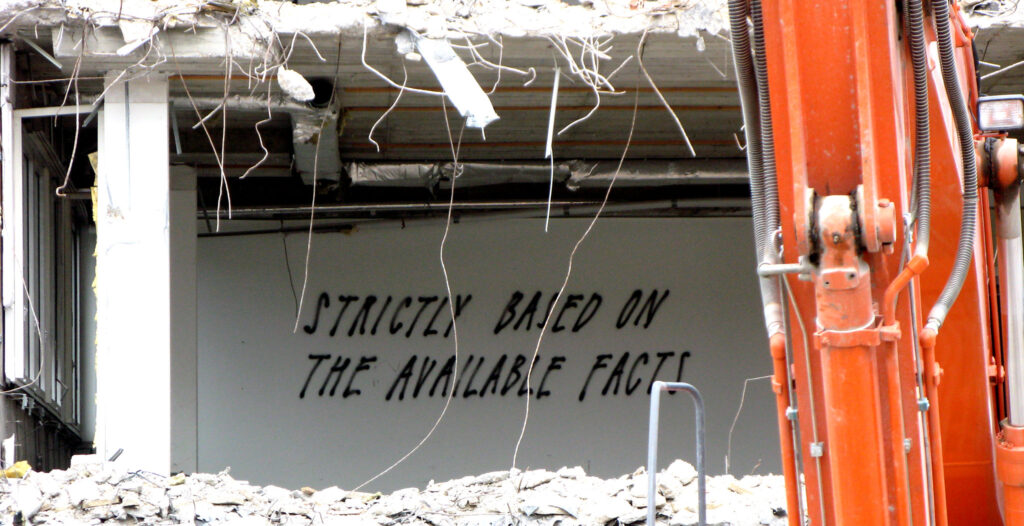
Evaluating Sources Part 1: Fact-Checking
“credibility” by flickr user Bob May, https://flic.kr/p/ruugue
Module Introduction
For this module, we will work evaluating sources, including into fact-checking habits that you can use every day, as it’s getting harder every week to separate fact from fiction in the news cycle. This module consists of the following activities:
- Watch the embedded videos (I also included the links to YouTube in case you can’t watch them here)
- Read a chapter from Web Literacy for Student Fact-Checkers
- Gut- and Fact-checking Padlet Post (4 points)
- Going upstream and evaluation Padlet (6 points)
Part 1 – Online Verification Skills
Watch the following videos. There are four that will play in order embedded below, and one additional video embedded under that. If you can’t get the embedded media to play, here’s a link to the YouTube playlist for the first four: https://www.youtube.com/playlist?list=PLsSbsdukQ8VYy88IiSJhz4NyBxxtLzsNr
One more video/skill – check the claim & find better coverage. This was clearly done during peak Covid, but the shortcut skill he demonstrates in this video is useful.
Part 2 – Check Your Emotions
Read the following chapter, “Building a Fact-Checking Habit by Checking Your Emotions,” from the online book Web Literacy for Student Fact-Checkers by Mike Caulfield: https://pressbooks.pub/webliteracy/chapter/building-a-habit-by-checking-your-emotions/
The above book is full of great tips and information for you as you are searching for materials online, so I urge you to read more than just the one chapter if you find it interesting: https://pressbooks.pub/webliteracy/
Part 3 – Gut- and Fact-Checking (4 points)
- Find a story or post online, via any social media platform (TikTok, Instagram, X, etc) that you think is intended to provoke an emotional reaction. We’ve all seen these types of “clickbait” stories. Social media is full of them!
- Check your emotions.
- Fact-check the claim(s) made in the story by reading laterally (move off the site in question and search what others say about it), Google the claim, and/or use a fact-checking site like Snopes.com, factcheck.org, or politifact.com.
- Finally, share the post on Padlet and write up briefly (1-2 sentences) what you learned about your news story. If you are unable to find anything on the fact-checking sites or via a Google search, that is important information as well – we want to know that you tried and what you did or did not find out.
Be sure to include your name on the post!
Part 4 – Going Upstream and Evaluation (6 points)
Choose one of the following links to investigate:
- America’s Fractured Trust in Science, Explained in 3 Charts
- Get DEI Out of STEM
- U.S. imports surged to record heights as consumers stocked up ahead of tariffs
- Where Will TikTok Refugees Seek Asylum?
- “Green Computing” and Woke AI Is a Gift to China
- The Most Expensive Judicial Election Ever
Then create a Padlet post under the source you chose. Briefly describe your process, what you noticed, and what you learned, addressing ALL of the questions below. This is a deeper investigation than we’ve asked you to do before, so please read and respond to all the prompts.
- Decode the URL using the skills you learned in Understanding URLs.
- Visit the link and observe what you can about the source.
- Is the organization in the URL the original source of the reporting?
- If not, where was this story originally reported?
- What sources did the author(s) draw on for this story?
- Read laterally, by using the Wikipedia trick for the source as you did earlier, but look a little deeper. Go beyond Wikipedia and see what else you can learn about the source of the information.
- What can you identify about the news organization? Is the organization named in the URL the original source of the reporting?
- Then “go upstream” to find original sources of content reported on in these stories. They all should have links out to other sources/content.
- What can you infer about this source from all the parts of your investigation? In what context(s) might this source be useful?

